LV-120
Level
80 GHz Radar Level Transmitter
Narrow-beam non-contact radar for tanks, vessels and silos.
ACCURACY
±1 mm
PROTECTION
IP67
01
PRODUCT FAMILY
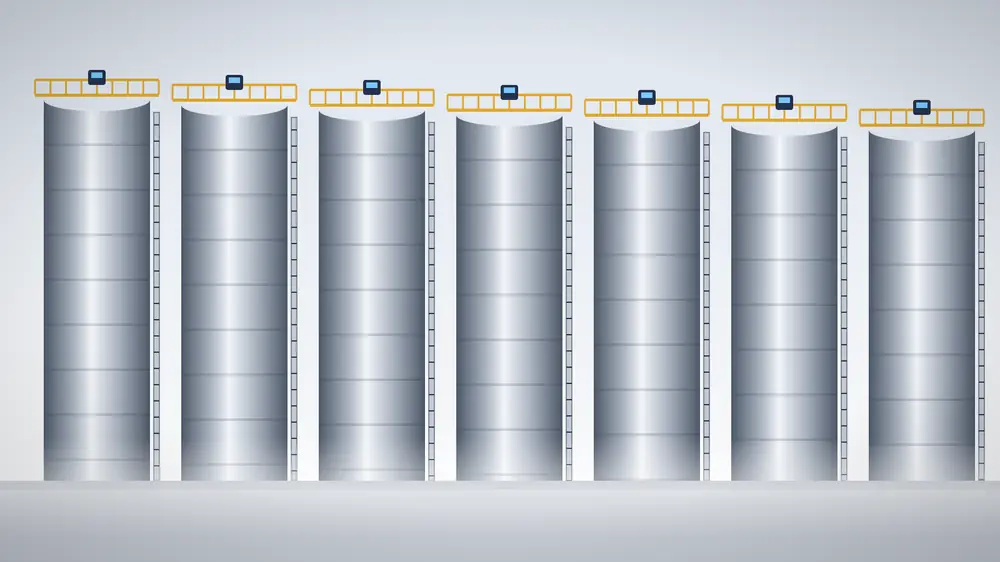
Know what is in the tank without touching it, and prove the high-level alarm will work when you need it.
Non-contact radar, guided-wave radar, ultrasonic and vibrating-fork instruments for continuous level and point detection in tanks, vessels and channels.
TYPICAL UNITS
m · mm
02
HOW TO CHOOSE
For clean, vapour-filled or corrosive tanks use 80 GHz radar (LV-120). Where foam, turbulence or interface detection matter, use guided-wave radar (LV-220). Open channels and sumps suit ultrasonic (LV-320). For overfill and dry-run protection add a vibrating-fork switch (LV-420).
MEASURING PRINCIPLE
A frequency-modulated radar beam reflects off the surface; the frequency offset between emitted and returned signal gives distance.
How it works →
MEASURING PRINCIPLE
Low-power radar pulses travel down a probe; the reflection at the liquid surface sets the level, and a second echo can show the interface.
How it works →
MEASURING PRINCIPLE
A sound pulse is timed from the transducer to the surface and back.
How it works →
MEASURING PRINCIPLE
A piezo-driven tuning fork vibrates at resonance; contact with product damps the frequency and trips the switch.
How it works →
03
INSTRUMENTS
LV-120
Level
Narrow-beam non-contact radar for tanks, vessels and silos.
ACCURACY
±1 mm
PROTECTION
IP67
LV-220
Level
Level and interface measurement through foam and vapour.
ACCURACY
±2 mm
PROTECTION
IP67
LV-320
Level
Economical non-contact level for sumps, wet wells and channels.
ACCURACY
±3 mm
PROTECTION
IP68
LV-420
Level
Maintenance-free point-level detection for liquids and solids.
ACCURACY
Switching point ±1 mm
PROTECTION
IP66
04
FAQ
RFQ
REQUEST A QUOTE
Describe the process and we will recommend a measuring principle and model, with a quotation.